From Data Chaos to Command & Control: Restoring Decision Confidence in a High‑Growth Global Holding
This transformation turned years of inconsistent, siloed reporting into a single controlled data foundation with a Golden Layer for all financial and operational KPIs. The group now makes decisions on investor‑grade numbers and can onboard new agencies in weeks, not months.
Executive Summary
A global marketing holding running dozens of independent agencies was losing control over its core financial truth: conflicting KPIs, inconsistent revenue and margin definitions, fragmented pipelines, and critical business logic trapped inside one person’s head. Leadership could no longer rely on a single, trusted version of the numbers used to steer the business.
We designed a governance first, SOX-aligned data foundation and a unified reporting model - creating one financial and operational truth for the entire group and establishing a repeatable operating rhythm across Finance, HR, and Operation.
Key Outcomes:
One unified version of revenue, margin, vendor spend, and headcount across all agencies.
Reporting scalability from ~100 to 12,000 users, without losing governance or control.
SOX‑aligned reporting lifecycle with full traceability and audit‑ready processes.
Elimination of single‑person dependency through institutionalised business logic and clear ownership.
Foundation for predictive planning & automation, enabling AI‑ready forecasting, variance analysis and faster M&A integration.
Client Profile & Business Context
Our client is a global marketing and communications holding composed of dozens of independentlyrun agencies across creative, media, technology, and digital services. Over the past decade, the group has grown primarily through acquisitions - inheriting heterogeneous systems, fragmented data structures, and varied reporting maturity.
As a result, the organisation operates with:
a distributed operational footprint,
inconsistent KPI definitions across Finance, HR and Media,
limited central governance over data and reporting,
and heavy reliance on labourintensive processes to consolidate performance.
The leadership’s ambition is clear: operate with consistent financial visibility, faster reporting cycles, and a data foundation capable of supporting ~12,000 employees as the group continues to scale.
Business Challenges
Summary of Key Issues
No Centralized Data Warehouse
Data dispersed across sources, systems, and manual workflows → no single version of truth.
Lack of Standardized ETL Process
Mixed tools (Cloud Functions, Colab, SQL scripts, manual uploads) → no orchestration, consistency, or auditability.
High Operational Effort & Limited Visibility
Duplicated pipelines, no logging or monitoring → constant firefighting and unpredictable reporting.
Weak Data Modelling Foundations
Report-specific fact tables and inconsistent dimensions → conflicting KPI definitions.
No Golden Data Layer
No validated financial/HR layer → multiple versions of revenue, margin, cost, and headcount.
No Structured Development or Backlog Process
No Jira governance, prioritisation, release management, or ownership model.
Decision risk - leadership sees conflicting numbers.
Implementation Approach
We approached this engagement as a control and governance problem, not a tooling exercise. The core objective: reestablish trust, consistency, and accountability in the numbers used by leadership.
Expose the Control Breaks
We conducted a cross‑functional audit with Finance, HR, Operations and BI, identifying where KPI definitions diverged, where processes relied on individuals, and where SOX‑critical controls were absent. This created a single, executive‑level view of risk.
Redesign the Reporting Model With the Business
Together with domain owners, we defined who owns which KPIs, how Golden Layer logic should work, what “auditable reporting” must look like, and how new agencies will onboard into the standard model. This ensured the future architecture is business‑approved, not IT‑invented.
Deliver Transformation in Structured, Risk‑Aware Releases
We sequenced work by business impact - Finance and HR first - replacing fragmented pipelines with governed processes, validating each release against business expectations and SOX requirements. This produced visible wins early while reducing operational exposure.
Replace Person‑Dependency With a Repeatable Operating Rhythm
We institutionalised logic, roles, workflows, and governance standards, enabling Finance and BI to operate with predictability instead of improvisation. The organisation now runs on process - not on individuals.
Solution Design
We delivered a single, controlled reporting ecosystem that replaces years of inconsistent, manual, and siloed reporting with a governed, auditable, and scalable data foundation.
The solution ensures that every critical metric - revenue, margin, vendor spend, headcount - flows through one consistent, monitored, and business‑approved pathway. Leadership can now operate on reproducible, regulator‑ready financial truth instead of reconciling conflicting numbers
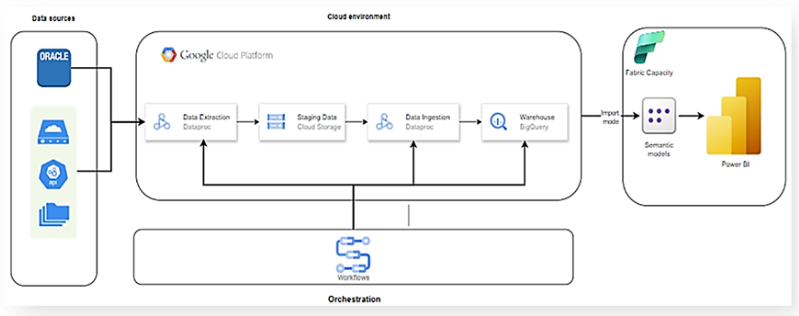
Target Architecture Overview
The target architecture ensures one governed flow of data from source systems to decisionmakers - replacing years of inconsistency and manual work with a unified, SOX-aligned operating model.
Controlled Ingestion Layer
Data from Finance, HR, Media and supporting systems enters the platform through a standardised, monitored ingestion process with consistent retention and traceability.
Business value: predictable data availability, fewer refresh failures, elimination of manual transfers.
Governed Warehouse Core
The warehouse becomes the single source of truth, embedding the Golden Layer for revenue, margin, vendor spend, headcount and unified dimensions across all agencies.
Business value: CFO‑grade reliability, one definition for every KPI, audit‑ready logic.
Enterprise Reporting & Managed Self Service
The Certified semantic models power Power BI through two controlled layers:
Enterprise BI → governed, certified, leadershipready
Managed SelfService → controlled flexibility for business teams
Business value: reporting scales from ~100 to 12,000+ users without losing governance or control.
Central Orchestration Layer
All data processes - ingestion, loading, transformation - run through a single orchestration layer, ensuring sequencing, monitoring and auditable execution.
Business value: operational stability and full traceability of how numbers are produced - a core SOX requirement.
Strategic Business Capabilities
A Single Source of Truth for Business‑Critical KPIs
Financial, HR and Media Spend data is consolidated into a governed central platform with business‑approved, standardised definitions - eliminating years of inconsistent reporting.
Governance‑First and SOX‑Aligned Design
Traceability, access separation, reproducible transformations, and documented ownership make the reporting lifecycle audit‑ready by design, not by exception.
Scalable Reporting Framework for 12,000 Users
A structured Power BI ecosystem (Enterprise BI + Managed Self‑Service), combined with RLS automation and consistent workspace governance, enables safe scale from ~100 analysts to 12,000 employees.
A Repeatable Operating Model for Data & Analytics
Clear ownership, Jira‑based delivery, certification rules and SteerCo governance replace ad‑hoc development with a repeatable, enterprise‑grade process.
A Future‑Proof Platform for AI and M&A
The governed data core enables automated variance analysis, forecasting and anomaly detection - and provides a standardised onboarding path for every new acquisition.
Business Impact and Results
Short‑Term Impact
One source of truth across finance, HR & Operations - All core KPIs aligned under Golden Layer → no more conflicting revenue/margin/headcount numbers.
Operational riskreduced - Critical logic moves from 1 person → institutionalised models, eliminating a major single point of failure.
Controlled reporting flows - Fragmented scripts replaced with one orchestrated pipeline → fewer errors, fewer manual fixes.
Report Development time: weeks → days: Reusable semantic models dramatically accelerate delivery (consistent with Target Architecture plan).
SOX Foundation established - Dev/Prod separation, lineage and controlled access → audit ready baseline.
AI-Assisted Variance Analysis - Quarterly variance analysis today takes ~1 week across dozens of entities. The proposed AI powered commentary parser consolidates and extracts explanations from agency files - accelerating an otherwise manual, error prone process → hours instead of days.
Rapid ad-hoc delivery (e.g., Regional Dashboard) - High value executive dashboards now delivered in days, demonstrating accelerated execution capacity.
Long‑Term Impact
Scalable reporting foundation, expanding from ~100 users to 12,000+ across the global organisation.
Higher data quality & trustworthiness - Data catalog, metadata governance, MDM roadmap → consistent, trustworthy data across the group.
Conclusion
Our work delivers far more than a modern data platform. It establishes a new operating system for how the entire organisation produces, governs and consumes financial truth. By replacing fragmented, inconsistent reporting with a single controlled data foundation - and by embedding clear ownership, audit‑ready processes and a scalable BI framework - the organisation moves from reactive reconciliation to proactive, insight‑driven performance management.
The transformation unlocks tangible business value: faster and more confident decision‑making at the executive level, a meaningful reduction in operational and compliance risk, and the ability to scale reporting from a small analyst group to the organisation’s full 12,000‑users workforce. Equally important, the group now has a repeatable M&A integration model, enabling each newly acquired entity to be onboarded into a unified reporting architecture rather than rebuilt from scratch.
With governance institutionalised and the Golden Layer in place, the organisation now operates on investor‑grade, reproducible numbers - a prerequisite for automation, predictive planning and advanced analytics. This shifts Finance from “fixing data” to analysing performance and shaping outcomes.
This transformation is not an IT uplift - it is a strategic capability that compounds over time: lower risk, higher speed, cleaner economics, and a data foundation ready for AI‑supported decisioning at scale.
In essence, the organisation now has something essential that few global holdings truly achieve.
We are here to answer your questions
Thank you! Your submission has been received!
Oops! Something went wrong while submitting the form.

%402x.svg)