From Silos to a Single Source of Truth: Unlocking On‑Demand Insights, Lower OPEX & AI at Scale
This Lakehouse transformation turned a fragile, $700k/year reporting stack into a unified data backbone that delivers $247k–$363k in annual savings and answers core market questions in hours instead of a month.
Executive Summary
A leading FMCG organization operated on a fragmented data landscape: 7+ independent engineering projects, no enterprise data warehouse, and a reporting tool used as the de facto integration layer. As a result, simple business questions - such as market share movements in a single country - required up to 30 days to answer, and scaling insights across the region could take more than 12 months.
The architecture was costly ($700k/year), fragile, and fundamentally blocked any AI or advanced analytics program. Critical executive dashboards were built on deeply nested semantic dependencies, creating operational fragility, high maintenance effort, and governance risk.
Our assessment exposed the structural issues and defined a unified, governed platform architecture enabling cost reduction, rapid insights, and true AI readiness.
Key Outcomes:
$247k–$363kannualsavings identified
Insight turnaround cut from 30 days toon demand potential
7 siloed projects consolidated into a unified Lakehouse strategy
Reporting tool repositioned: from ETL engine → governed consumption layer
AI/ML enablement unlocked via harmonized, conformed, certified data
Governance redesigned, replacing 47-step approvals with predictable workflows.
Client Profile & Business Context
The client is a leading global FMCG organization, operating in one of the most competitive commercial environments, where speed, pricing agility, and market insight directly influence revenue and share. Leadership expected:
Realtime visibility into market dynamics
Reliable, stable executive dashboards
AIready infrastructure to support future growth
Efficient, scalable data operations free from duplication and manual overhead
However, strict global policies, fragmented architectural choices, and legacy systems created a highcost, lowspeedoperating environment that constrained commercial decisionmaking and strategic initiatives.
Business Challenges
Fragmented Architecture with High Hidden Cost: Over seven independent engineering projects operated in silos, each with its own pipelines, logic, and cloud resources. The same data was ingested, processed, and stored multiple times across different systems - driving cost upwards while creating inconsistent “truths” across the organisation. This fragmentation made scalability impossible and slowed every strategic insight.
Power BI Misused as an Integration Engine: Due to global policy constraints, cross-domain data could only be joined inside Power BI - a visualization tool acting as an ETL system. This produced 6-level nested semantic dependencies, duplicated business logic, and fragile refresh chains. The company’s most important executive dashboard relied on 46 data sources and circular dependencies, making every update a high-risk operation.
Governance That Created Operational Drag: Even simple infrastructure changes required up to 47 approvals across global and local teams. With no unified intake, no prioritisation, and no ROI tracking, engineers were forced into reactive delivery with little autonomy. The governance model did not protect the platform - it slowed it down - and created burnout and attrition risk across analytics teams.
Strategic Insights Delivered Too Slow to Act On: A single competitive analysis - such as understanding market performance in one key country - required nearly a month of manual work, involving multiple extracts, custom data stitching, inconsistent access rights, and unclear ownership. Scaling this insight across all regional markets would take more than a year. The issue was not analyst capacity - it was the underlying architecture.
$700K Annual Spend Without Efficiency: Infrastructure costs reached $701.7K annually, driven by outdated technologies, duplicated pipelines, and full-refresh patterns. Azure Analysis Services alone consumed over $351K per year. Without architectural change, the organisation had no path to reduce spend - and no way to scale without increasing it further.
AI Aspirations Blocked at the Foundation Layer: The organisation had the skills and ambition to deploy AI, from ML models to semantic copilots. But without conformed dimensions, a unified data platform, or governed feature stores, no model could be trained reliably. Fragmented silos didn’t just slow AI adoption - they made it structurally impossible.
Implementation Approach
Stabilise What Exists, Then Remove the Root Causes
We began by identifying architectural bottlenecks, semantic inconsistencies, pipeline duplication, and governance failure points. This phase provided the clarity needed to eliminate fragility rather than simply masking symptoms.
Design a Scalable Target Architecture
A unified Lakehouse blueprint was created, covering ingestion, transformation, modeling, governance, and reporting. This architecture introduced consistent standards and guardrails across engineering and BI teams.
Iterative Migration Focused on Business Value
The roadmap followed a stabilise → unify → accelerate sequence. High-value workloads and reports were migrated first, providing early wins and reducing infrastructure costs quickly. Migration pipelines were automated and validated end-to-end.
Embed Governance, Roles, and Ways of Working
We introduced a modern governance model with clear ownership, predictable intake, and transparent prioritisation. Engineering, BI, and analytics teams received role clarity, training paths, and operational guardrails - ensuring sustainability beyond the project.
Enable AI by Design, Not as a Side Project
All metadata, lineage, and business rules flow into a vector knowledge base powering LLM copilots and AI-driven insights. This ensures that every future AI use case runs on governed, trusted, and explainable data.
The Solution
One Unified Enterprise Lakehouse
All seven engineering projects are consolidated into a single governed Lakehouse architecture. This creates an end‑to‑end data backbone covering ingestion, storage, transformation, governance, and BI consumption, eliminating duplication and producing one version of truth for all markets.
Business Value: Creates a single, trusted data foundation enabling faster executive decision‑making, while reducing duplicated engineering work and overall operational cost.
Power BI Repositioned to Its Proper Role
ETL logic is removed from PBIX files and centralised in the Lakehouse. Power BI becomes a lightweight, stable reporting layer underpinned by SQL Warehouse and certified semantic models.
BusinessValue: Stabilises leadership dashboards and significantly cuts maintenance effort, while ensuring consistent KPIs across markets through reusable semantic models.
Cost-Optimised, Metadata-Driven Ingestion
A standardised ingestion and ELT framework replaces multiple custom pipelines. Incremental refresh, AAS rightsizing, cluster tuning, and serverless compute reduce costs while improving performance.
BusinessValue: Delivers immediate annual savings of $247K–$363K, while improving ingestion reliability and accelerating onboarding of new data sources.
Governance That Enables, Not Blocks
A new operating model introduces clear intake, prioritisation, ownership, and delegated approvals. Unity Catalog unifies metadata, lineage, and security across the platform.
BusinessValue: Accelerates delivery cycles through streamlined decision‑making, while increasing trust and reducing manual effort with complete lineage and centralised governance.
AI Enablement Built Into the Foundation
Harmonised data, conformed dimensions, and a governed feature store enable operationalisation of ML models, Copilots, and natural‑language querying.
BusinessValue: Enables scalable, production‑grade AI use cases with higher accuracy, while reducing BI workload through automated, natural‑language insights.
Business Impact & Results
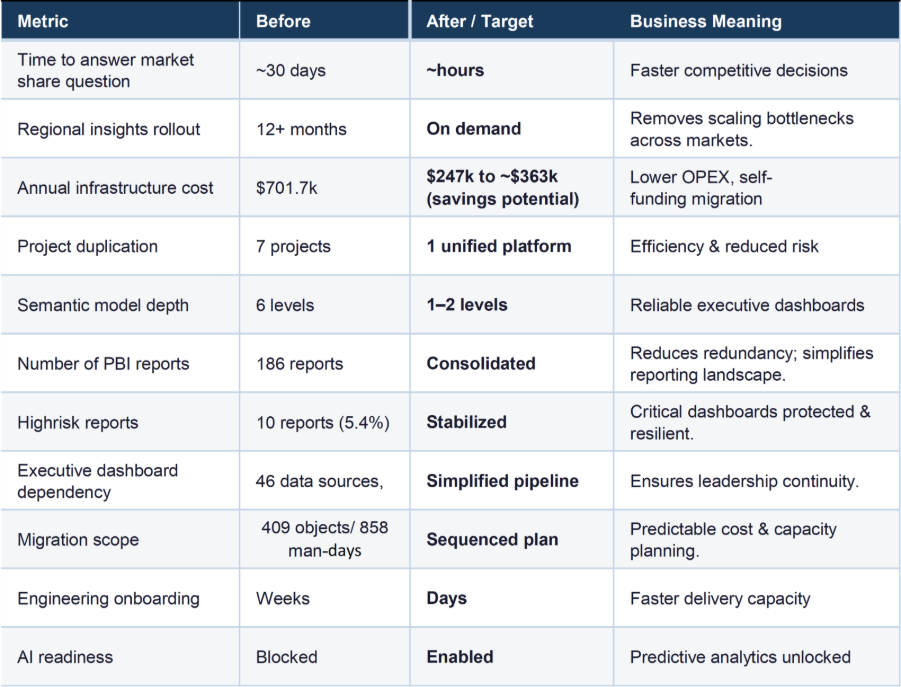
Cost Efficiency: The organization unlocked over $247k in immediate annual savings, with a total potential reduction of $363k across cloud services. Consolidating seven parallel projects into a single platform removed duplicated compute, storage, and maintenance overhead.
Speed & Agility: Insight delivery accelerated dramatically. Competitive analysis that previously required ~30 days can now be produced in hours, while regional scaling moves from year‑long efforts to near‑instant deployment. New data sources can be onboarded within days rather than weeks.
Risk & Continuity: Critical executive reporting was stabilized by removing multi‑level semantic dependencies and consolidating logic into a governed data layer. Leadership now operates on reliable, predictable insights with significantly reduced operational fragility.
Productivity Uplift: Engineering teams shifted from firefighting to value creation, supported by clear ownership, standards, and unified pipelines. This increased delivery capacity and improved morale across BI and analytics functions.
AI-Ready Operating Model: With a unified Lakehouse, conformed dimensions, and feature store foundations, the organization can operationalize AI and ML workloads at scale. Business users benefit from natural-language interfaces and consistent data understanding.
Key Metrics Summary
Conclusion
The organization has shifted from a fragmented and resource‑intensive data environment to a unified, strategically governed platform capable of supporting the next decade of growth. By consolidating seven independent solutions into a single, scalable architecture, the company has restored the speed, reliability, and cost efficiency required for modern decision‑making.
What previously demanded weeks of manual effort can now be delivered on demand, enabling more timely responses to market dynamics and operational pressures. Equally important, the new architecture establishes a foundation on which advanced analytics and AI can be deployed consistently across markets - turning data from a constraint into a long‑term competitive enabler.
The broader lesson is clear: Organizations do not gain strategic clarity from isolated systems. They gain it from coherent architecture, disciplined governance, and the ability to scale insight as fast as the market moves. The transformation created a virtuous cycle: better data → better decisions → better results, which in turn generated enthusiasm for further improvements. This is the hallmark of successful digital transformation - not the technology itself, but the business and cultural change it enables.
We are here to answer your questions
Thank you! Your submission has been received!
Oops! Something went wrong while submitting the form.

%402x.svg)