%402x.svg)
A practical map of how AI moves through a data team, from copilots to autonomous agents. Where most teams are today, and what the next 12 to 18 months actually look like.
By Michał Dębski, co-founder of Astral Forest · For CDOs and Heads of Data
The five waves and their productivity uplift
Humans with Copilots: about 10%
Humans with Agents: up to 30%
Agents with Humans: 30 to 50%
Agents: to be confirmed
Autopoietic Agents: to be confirmed
The author's estimates of uplift across a team's whole mix of work, which is why they are smaller than the single-task result below. Waves 4 and 5 are research directions.
One high-complexity task type at a global manufacturing group, moved from Wave 1 to Wave 2
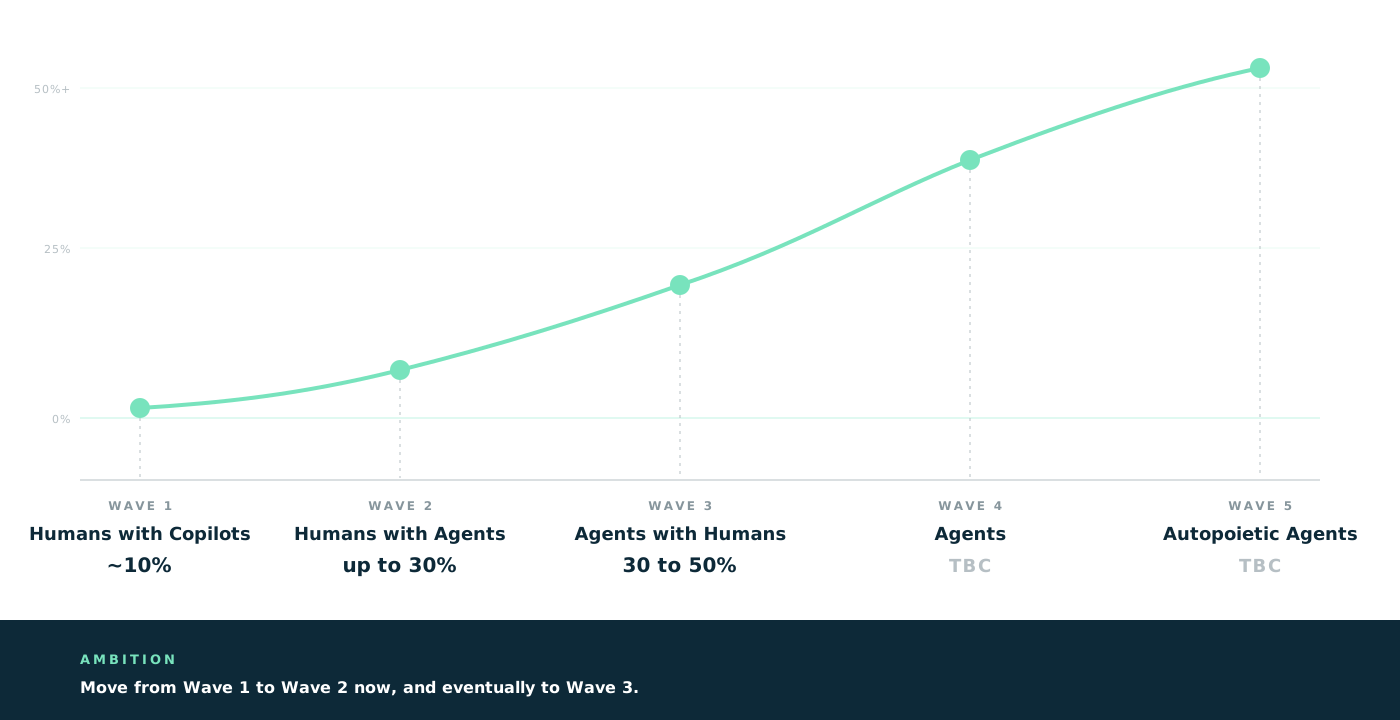
The Five Waves curve. Uplift figures are the author's estimates across a team's whole mix of work.
No change to the team. Same lifecycle, same handoffs.
Same roles, new tools. Agents execute tasks; humans approve at two checkpoints per task.
Roles shift towards review and governance. The agent polls Azure DevOps on a schedule, proposes a solution as a task comment, implements on approval and opens a draft pull request; humans approve the comment and review the pull request.
Smaller, more senior teams. No human in production execution.
Self-modifying agent ecosystems.
Reality check. Waves 4 and 5 are research directions, and pricing your transformation against them today is fiction. This page stays inside Waves 1 to 3, which a data team can plan, measure and govern today.
Most AI programmes in data teams stall at Wave 1. They buy copilot licences, measure a 5 to 15 percent gain, call it adoption, and the way the team works stays exactly what it was.
One real high-complexity task before agents, the kind that comes up several times a month: 11 person-days. Developers may use a copilot in the IDE, but no agent touches tickets, specs or code, and everything stays inside your tenant.
About 73% of the total: five days to analyse, discuss and implement, two and a half days of sandbox testing, and half a day for the pull request and peer review.
About 27%: UAT, deployment and a manual data reload, the joint responsibility of the project manager, the key user and the data and analytics team.
Validation stays roughly the same in every wave. The developer's hands-on time is the lever, and Wave 2 pulls it first.
The agent reads the team's tickets, specs and code before it proposes anything: the Azure DevOps task and its comments, linked epics, source-to-target mappings in SharePoint. Context comes from these existing sources plus a curated instruction file for the agent (CLAUDE.md in Claude Code).
The developer accepts the proposed solution before any code is written, then approves the pull request before merge. Between the gates, the agent does the work and the developer reviews artefacts.
The developer triggers the agent, runs the sandbox tests and keeps every decision.
Most data teams already own every component. The blocker is process design and approval discipline, not only technology.
An agent that supports MCP (Model Context Protocol): Claude Code, Cursor agent or Cline.
Served from your own cloud: Microsoft Foundry on Azure, Amazon Bedrock on AWS or Snowflake Cortex.
Read access for the agent to your ticket system: Azure DevOps, Jira or Linear.
Read access to specs: SharePoint, Confluence or Notion.
A sandbox environment per developer. Existing CI/CD usually suffices.
A human approval per task before any code is written, and per pull request before merge.
A measured baseline: how many person-days does one task of the type you start with take today?
Days 1 to 30: pick one workflow, measure the baseline
Identify one repeating, high-volume, low-risk task type, such as a bug fix, a source-to-target mapping, a dbt model change or tickets from meeting notes. Measure the actual person-days per task today across three people, three tasks each. This is the number Wave 2 has to beat.
Days 31 to 60: wire one agent to one source of truth
Set up MCP for your ticket system and a sandbox per developer, and codify the CLAUDE.md for that one workflow. Run the agent on 5 to 10 tasks and measure the new person-days per task.
Days 61 to 90: measure, expand, codify
Compare the new effort to the baseline and calculate the uplift. Document what works and what does not, add a second workflow and repeat the setup pattern.
Keep it bounded: one workflow, one ticket system, one developer team. Most Wave 1 to Wave 2 attempts stall because the team tries to transform too much at once.
Without a curated CLAUDE.md and knowledge base, the agent produces plausible-looking work that does not match your conventions. Treat context as the product.
Developers stop reading the agent's proposals carefully after the first week. Build in spot-check audits.
"Who owns this?" is the question that stalls more Wave 2 rollouts than any technical issue. Decide before you start.
The AI-Augmented Data Product Lifecycle. PDF, 14 pages, for CDOs and Heads of Data. Free, with no sign-up.
From discovery call to refined backlog in 30 minutes.
The full 15-step worked example.
Four dimensions across five waves.
When and where they fit.
With measured baselines, and how teams that ship Wave 2 avoid the three traps.
The Five Waves describe how AI moves through a data team. Wave 1 is Humans with Copilots (individual IDE assistants, around 10 percent productivity uplift). Wave 2 is Humans with Agents (AI agents execute tasks, humans approve at two checkpoints, up to 30 percent). Wave 3 is Agents with Humans (agents own the loop, humans own the checkpoints, 30 to 50 percent). Wave 4 (Agents) and Wave 5 (Autopoietic Agents) are research directions, with no uplift figure yet at production scale. The uplift figures are the author's estimates across a team's whole mix of work.
Most data teams are in Wave 1. Developers use copilots in their IDE, the organisation claims AI adoption, productivity moves 5 to 15 percent, and the way the team works stays the same. This is the floor of what is possible with current technology, and most teams stop there.
Wave 1 has copilots inside the IDE only, with no change to the team or the lifecycle. Wave 2 has agents reading the team's tickets, specs, and code, then proposing and executing work while humans approve at two checkpoints per task. The lifecycle steps stay the same and who executes them changes: the agent does the work between two human gates. Team composition does not change.
For most organisations, no: they are 12 to 18 months from Wave 3. The technology is already in place; the work between Wave 2 and Wave 3 is governance maturity, and it cannot be shortcut.
Genie, Cortex, and Copilot for Fabric are natural-language interfaces inside the data platform. The agent pattern in the Five Waves framework works across the delivery toolchain, where tickets and specs become dbt code, tests and merged pull requests, so most teams will use both.
Eight to twelve weeks for one bounded workflow on existing infrastructure. The 90-day path: Days 1 to 30 pick one workflow and measure the baseline. Days 31 to 60 wire one agent to one source of truth. Days 61 to 90 measure, expand, and codify into a playbook.
Most data teams already own everything they need. The components are: an MCP-capable agent (Claude Code, Cursor agent, Cline), an enterprise ticket system (Azure DevOps, Jira, Linear), and a spec source (SharePoint, Confluence, Notion). The blocker is process design and approval discipline more than tooling.
Two clear human approval gates per task: one before code is written (developer accepts the proposed solution) and one before merge (developer approves the PR). The agent has read-only access to the team's sources of truth. For Wave 3, governance maturity extends to per-repo service principals, agent action audit trails, and cost controls on autonomous loops.
The one-day workshop applies this framework on a stack that mirrors yours. An agent takes a ticket to a pull request while your team approves at both gates, and the team keeps the runbook and a governance and cost playbook. On-site, for up to 12 people, on synthetic data or an anonymised mirror of yours, so your production systems stay untouched.
Michał Dębski, Co-founder, Astral Forest
Managing Director and Solution Architect, with 15 years inside complex organisations across Europe and beyond. Michał works with CDOs and Heads of Data who want a peer in the room, someone who builds, not only presents. Astral Forest is a boutique data and AI consultancy: we architect, we build, and we hand the keys over. LinkedIn · Podcast: No Hallucinations
